
The need to adapt to market disruption is staring us in the face. If we are brave enough to open our eyes, we see the convergence of a massive labor shortage, constraints in the supply chain, an ongoing pandemic, the highest inflation in 40 years , and the very real possibility of a recession. Yet we’re still expected to not only turn a profit, but actually hit our growth goals. How can business leaders find their way in the midst of these disruptions? By taking action now. Global top-tier consulting firm Bain & Co’s research from the past 13 years shows that companies who took opportunities during the 2008 recession vastly outperformed those who did not:
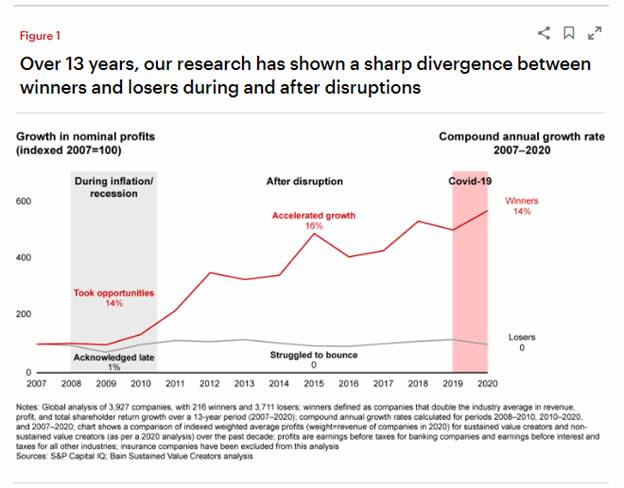
The author advises, “Turbulent times shouldn’t stop companies from pursuing full potential and business resiliency.” The strongest companies are currently taking advantage by mitigating the impact of disruptions and finding opportunities unique to an economy under stress. The starting point is fortifying the resiliency of operations through crystal clear visibility into the performance metrics that most impact outcomes.
When the pressure is on, the margin for error is tight, and poor instrumentation will leave you caught unaware of issues that can become crises in a matter of days: order-to-cash velocity, project schedule and profitability, projected backlog, and field technician utilization. When any of these slip off track undetected, even for a short period of time, you can find yourself in a crisis that forces a draw-down and rebuild when you can least afford it.
Accurate, timely instrumentation is a non-negotiable when navigating rough waters. While the adage, “You don’t fatten a pig by weighing it” holds true on a farm, experience shows that in business, “what gets measured, gets managed.” This is business intelligence in a nutshell.
If your mode of operation is to manage by reaction and survive by putting out fires, you’ll remain undifferentiated from the majority of competitors, most of whom operate the same way. Similarly, if you’re a leader in your niche, you’ve probably learned the secret shared by the world’s most successful companies: keeping your key performance metrics front and center throughout the organization will fatten the pig every time, almost as if by magic.
Having started and managed several businesses over the past few decades, we’re convinced that data analytics and dashboards are the most effective way to measure and manage any business—and to put strategy into action. This creates team accountability and individual job ownership, positioning a business to thrive during even the most turbulent times. This is the key to building resilient operations.
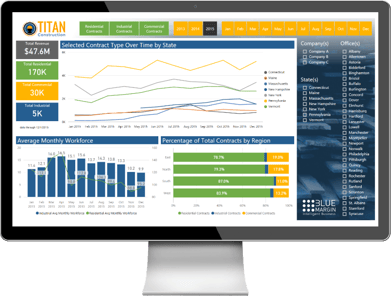
By “dashboards,” we mean displaying business-critical information graphically and numerically in narrative form. The right dashboards inform decision-making and motivate everyone at every level of the organization to focus on the priorities that most impact growth and profitability.
In other words, dashboards don’t just spotlight critical issues—they change the very behaviors that best address those issues. This twofold effect creates a virtuous cycle that accelerates growth more quickly and at lower cost than any other tactic we’ve seen in our business tenure.
We call it The Dashboard Effect , and until recently it has been the all-but-exclusive domain of large companies. Today, thanks to a rapid evolution in tools that more affordably deploy business intelligence (or “BI,” VC-speak for visual analytics), dashboards are quickly becoming a business prerequisite for employee engagement and operational efficiency.
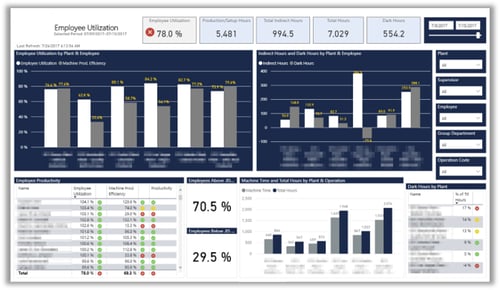
Dashboards aren’t simply a more visually appealing way to present data. They turn otherwise static spreadsheets into real-time interactive charts, graphs, and tables that make exploring data more compelling—and much more impactful.
For more information on The Dashboard Effect, download our book: The Dashboard Effect . If you’re ready to start a conversation about how companies can use their data to increase efficiency and profitability, get in touch with us here.