

Data-Driven Change Management
Why Is Data-Driven Change Management Important?
If data science were a tool in a construction tool belt, it would be the measuring tape. During the change management process, data science measures employees’ behavioral changes, change readiness markers, goal achievement, implementation timelines, and leadership tactic effectiveness, among other potential change indicators. As this reference set grows, so does the ease of predictive organizational change models, which help companies understand which actions will accelerate adoption of new behaviors, practices, and processes.
However, despite data’s expanding utility in change management, it is often underused. A leader forging change without data is like a home contractor building without a measuring tape. In a recent Expert Insight Series interview, industrial psychologist Dain Johnson reflected:
“Despite the tools available, people still use their intuition to make people decisions. There’s a better way.”
Dain Johnson, Industrial-Organizational Psychologist, Rev 0 Consulting
The cost of that intuition gap compounds quickly. When leaders make change decisions without behavioral data, they tend to misread adoption rates, overinvest in interventions that are not moving the needle, and underinvest in the areas where resistance is actually building. Failure of bias is one of the most common reasons organizational change efforts stall, and data is the most direct correction available.
What Is the Better Way to Lead Change?
Research by Deloitte suggests that incorporating data into the change management process drives better change outcomes. High-performing organizations are 3.5 times more likely to use data to inform change efforts than those relying primarily on intuition. Deloitte’s latest research drives change with a four-step data model called Transformation Intelligence, which incorporates data into every stage of the change process rather than relying on human intuition at any point along the way.
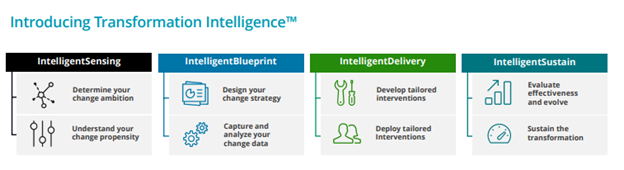
Source: Deloitte
The four stages of the framework move from listening and sensing, where organizations gather data about readiness and resistance, through to sustaining, where behavioral data confirms whether change has been genuinely embedded rather than superficially adopted. The value of this model is not its complexity. It is its insistence on treating change adoption as something that can be measured and managed, not just hoped for.
What Is the Best Place to Start Using Data in Change Management?
Many organizations may not be ready for a full enterprise change management program, but they can start by incorporating practical tools to support change adoption. Automated dashboards tracking key metrics can drive an objective change process through transparency and data visibility, and app-based training tools can improve employee adoption of new processes.
Equipped with the right tools, leaders can make decisions based on users’ actual behavior rather than relying solely on intuition. Business intelligence dashboards allow companies to track quantitative employee behaviors, such as adoption levels of newly deployed software, in addition to qualitative survey data. Technologies such as data analytics and AI and machine learning take it a step further by offering predictive modeling to forecast the effectiveness of leadership decisions within different subsets of people, including geographies and cultures.
Building the Data Foundation for Change
Data-driven change management requires a data environment that is reliable enough to trust in real time. If leaders are working from reports that are days old or built on inconsistent definitions, the behavioral signal gets lost in the noise. A managed data platform that keeps performance metrics current and governed is the infrastructure layer that makes Transformation Intelligence practical rather than theoretical.
Understanding where your organization sits on the data maturity curve is the right starting point for knowing what is realistic to measure today and what requires building first. Designing those dashboards for adoption from the start is what ensures the measurement actually reaches the people managing the change, not just the executives reviewing summary reports.
An intentional integration of data into change management efforts will position businesses to be more agile in navigating inevitable changes ahead. Talk to Blue Margin about building the data visibility your organization needs to lead change more effectively.