

Artificial Intelligence: Stop Tripping Over Dollars to Pick Up Dimes
Few would argue that companies operating across traditional industries including manufacturing, distribution, healthcare, and others do not need to elevate data as a strategic asset to remain competitive.
According to PwC, as the global marketplace becomes more competitive and as companies look to embrace digital transformation to outpace their peers, sound data collection, governance, and architecture will play a key role in avoiding obsolescence. This includes establishing a modern data warehouse and deploying persona-centric dashboards that support the awareness, analysis, and action employees need to advance the business.
Unfortunately, many companies, especially those in the middle market, are not yet wired for data. They often lack the foundation of a modern data lake or managed data platform to streamline the process of adding business units and data sources in the buy-and-build model. Furthermore, most companies lack command of best practices for dashboard development, opting for order-taking from SMEs or building topic-centric dashboards rather than role-specific and narrative-driven dashboards. If a company has not mastered fundamental data management and reporting, it is in no position to deploy more advanced data tools such as AI and machine learning. In the following spectrum of data capabilities, most companies never even find their footing in Descriptive Analytics. This is the greatest oversight hindering the progress of most businesses today.
What About Advanced Analytics?
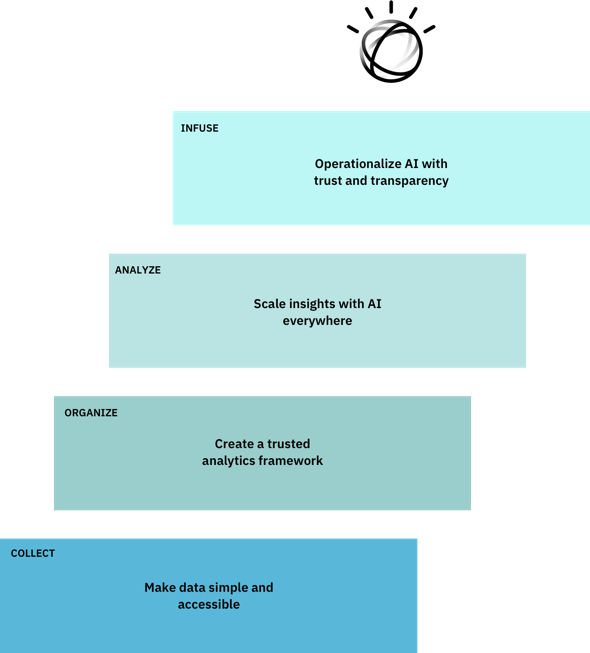
The AI Ladder, a framework developed by IBM, outlines four steps that an organization must complete to optimally deploy AI and advanced analytics. The four steps, ordered from least to most sophisticated, include Collect, Organize, Analyze, and Infuse. Unfortunately, many companies are stuck on the Collect and Organize rungs. The reason is they get caught up in the buzz words of big data, the Fourth Industrial Revolution, and artificial intelligence, causing them to overlook the blocking and tackling that delivers roughly 80 percent of the value of business data. Rather than looking for a magic bullet in the form of AI, the most effective firms understand that the low-hanging fruit in their data is reliable, timely, and centralized reporting that keeps everyone in the organization acutely aware of their performance and focused on the highest value-creation priorities. The lesson here is do not trip over dollars to pick up dimes, where dollars are operational dashboards and dimes are the misty vision of an AI breakthrough.
IBM’s AI Ladder
So how does a mature company operating in a traditional industry start using its data as a strategic differentiator? By first focusing on the Collect and Organize rungs of IBM’s AI Ladder. When collecting and gathering data, removing silos is a great place to start. If a mid-market company is not able to quickly pull machine utilization or production quality from a data warehouse into a dashboard, it will be hard pressed to deploy machine learning algorithms to predict factory utilization and demand patterns anytime soon. Additionally, once data is properly gathered, it must be organized, integrated, and cleaned. The data in a data warehouse must be curated so end-users, analysts, and data scientists understand what is in there and what it means. To manage and utilize data for competitive advantage, context and governance are paramount.
Climbing the first two rungs of the ladder, and by extension establishing AI readiness, requires a proven and intentional process for data governance and management. Deploying a cloud-based modern data platform that serves as a scalable, integrated repository and the single source of truth is a good place to start. It is not uncommon for traditional mid-market companies to have data scattered in miscellaneous Excel reports, ERPs, and other source systems. Establishing a central repository sets the foundation for advanced analytics and serves as a cornerstone for an organization climbing toward the fourth rung, Infuse.
Data-Driven Culture
You have to walk before you run. Companies looking to advance along the analytics maturity continuum must first master the lowest rungs of the ladder. A core step in this process is establishing a high-performance BI ecosystem that improves business outcomes by touching the right nerves throughout the organization daily and changing behavior. The goal is a culture empowered by a sense of ownership, shared accountability, and a common mission. Understanding where your data environment sits today is the right starting point for knowing how far that journey is and where to invest first. And as an added benefit, becoming data-driven lays the foundation for AI capabilities that are no longer on the horizon but already reshaping how the most competitive mid-market companies operate. Talk to our team about building the data foundation your organization needs.