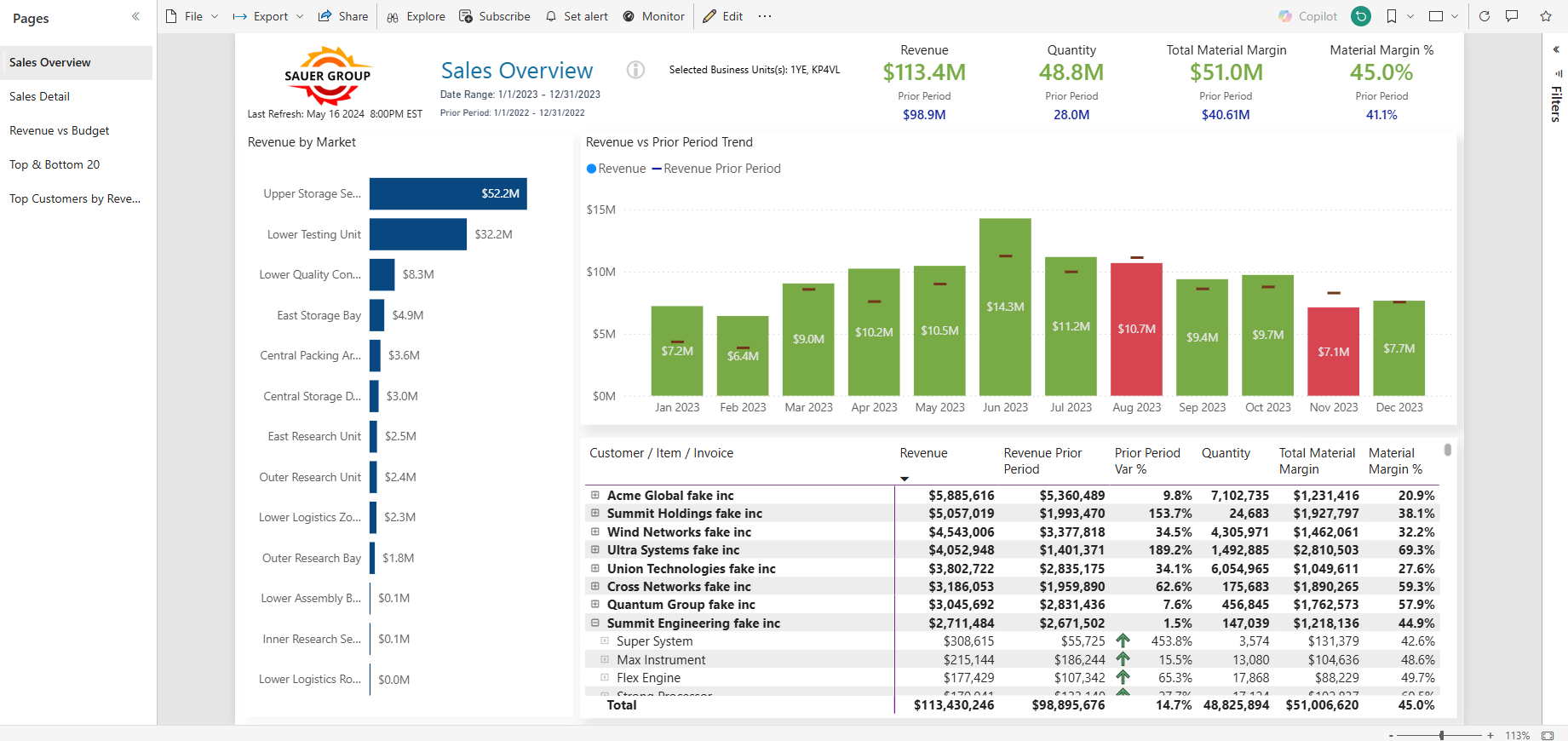

Goals of a Data Warehouse
- Enable efficient development of accurate, performant, and secure reports that deliver critical insights to improve business outcomes.
- Support the efficient addition of new data sources while maintaining performance and scalability.
- Support future, unknown reporting needs and adapt quickly to changing business requirements.
Introduction: Inmon vs. Kimball
When determining the right data warehouse architecture, the two most commonly discussed methodologies are those of Ralph Kimball and Bill Inmon. The Kimball method, formalized in the late 1990s, emerged as the preferred approach for building modern, agile data warehouses. The Inmon method, by contrast, reflects the traditional, monolithic enterprise data warehouse, often referred to as the Corporate Information Factory (CIF).
Blue Margin primarily relies on dimensional modeling (the Kimball approach) while selectively incorporating normalized schemas (the Inmon approach) at the warehouse level when they simplify ingestion or storage. This hybrid—often referred to as a modern data warehouse—balances agility with governance and aligns with prevailing best practices.
- Enable a scalable, secure, and robust reporting data model
- Support rapid delivery of actionable reports
- Allow modular expansion to new data sources and subject areas
- Remain simple to understand, document, and manage
What Is the Inmon Method?
The Inmon method specifies building fully normalized (third normal form) databases that minimize data redundancy. This approach reduces duplication and can simplify data loading while conserving storage.
However, these benefits introduce complexity. Analysts must navigate many tables and joins, limiting effective use to specialized users. To offset this, Inmon proposes building dimensional data marts on top of the normalized warehouse—an approach that adds yet another architectural layer.
The Inmon methodology follows a top-down, waterfall-style approach. Schemas are defined upfront, development cycles are long, and reporting typically cannot begin until the warehouse is largely complete. Structural changes later in the lifecycle are often slow, expensive, and risky.
- Lower data redundancy
- Higher complexity due to more tables and joins
What Is the Kimball Method?
The Kimball method is based on dimensional modeling and star schemas, where denormalization is inherent to the design. These models are optimized for reading, aggregating, and analyzing numeric data and applying descriptive dimensions such as customers, departments, and geographies.
Kimball supports an agile, modular approach that enables faster delivery, lower cost, and a shorter path to insight. This is especially important as self-service BI adoption increases across organizations.
When data warehouses are slow to adapt, teams often create shadow data marts, leading to governance issues and inconsistent metrics. Kimball-style warehouses respond more quickly to business needs, reducing friction and information silos.
Most modern BI tools—Power BI, Tableau, Qlik, Excel PowerPivot—are optimized for dimensional models. Storage costs are now negligible, making data duplication a non-issue in most cases. Performance is often superior due to fewer joins and simpler query paths.
The Blue Margin Approach
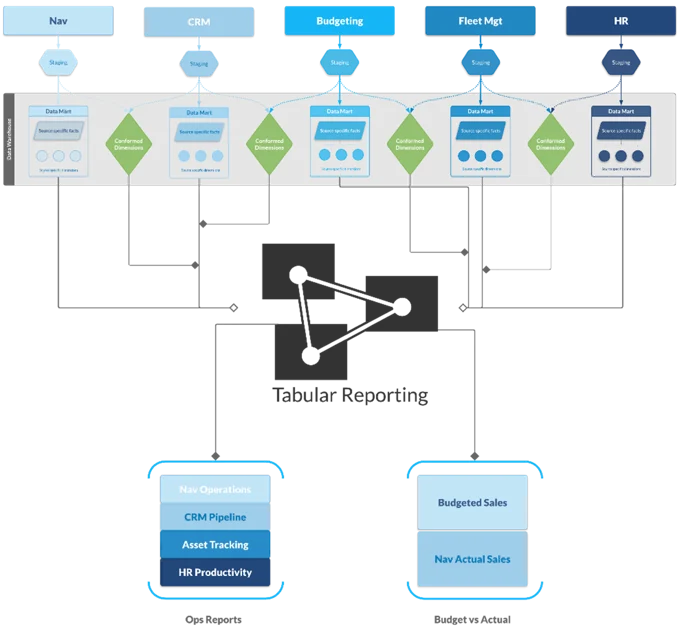
Blue Margin’s data management solution embraces Bimodal BI, blending the agility of star schemas with selective Inmon elements where governance, reliability, security, or scale demand it.
This hybrid approach delivers fast ROI by prioritizing immediate reporting needs while enabling efficient expansion over time. Kimball modeling typically dominates early, with Inmon elements introduced only when the value is clear and justified.
Even when normalized structures are added, we preserve a dimensional (star schema) OLAP layer to ensure accessibility for analysts and report consumers.
Strategic Considerations for Data Warehouse Best Practices
- Protects operational systems
- Minimizes direct access to transactional systems, preserving performance and reducing risk.
- Preserves historical accuracy
- Maintains historical context as business rules and structures evolve.
- Supports regulatory compliance
- Enables centralized compliance for standards such as SOX, PCI, HIPAA, and SSAE16.
- Enhances security and auditability
- Granular access control by role and credential
- Full auditing of data access and changes
Simplifying Data Warehousing for Business Success
A fully centralized, Inmon-style data warehouse resembles a centrally planned economy: logical and comprehensive, but slow to adapt. When assumptions change—as they inevitably do—adjustment is costly.
By contrast, a modern data warehouse is decentralized, agile, and driven by real business needs. Business users adopt tools they understand, and dimensional models provide a gentler learning curve while enabling rapid insight through modern BI tools .
Our hybrid modeling philosophy applies equally to lakehouse architectures.
Want to learn more? Schedule a demo with one of Blue Margin’s Business Intelligence Consultants.